
Khao Yai in the Rain: Go Greener, Spend Less, See More
Who says the rainy season is a time to stay indoors?
For travellers who love nature, Thailand’s green season can actually be one of the most exciting times to explore. Accommodation rates are often more attractive, popular destinations feel less crowded, and the landscape transforms almost overnight. Forests become intensely green, waterfalls return to full strength and, if luck is on your side, mist drifts across the mountains after the rain.
In other words, a little rain can come with some very good rewards.
And if you want a rainforest escape without travelling too far from Bangkok, Khao Yai National Park makes an easy choice.
Why Travel to Khao Yai in the Rainy Season?
Rainy-season forest trips are admittedly a little more unpredictable. Trails can be wet, skies can change within minutes and some areas may temporarily close for safety or to allow nature to recover.
But this is also when the forest feels most alive.
Leaves seem greener, streams run faster, waterfalls roar louder and the air carries that unmistakable fresh scent of earth after rain. There are usually fewer visitors than during the cool-season peak, while hotels and resorts around Khao Yai may offer more appealing green-season rates.
For anyone willing to trade perfectly blue skies for dramatic clouds, spontaneous showers and landscapes bursting with life, it can be a wonderful deal.
Khao Yai is particularly appealing because it is relatively easy to reach from Bangkok. Thailand’s first national park, it forms part of the UNESCO-listed Dong Phayayen–Khao Yai Forest Complex and stretches across parts of Nakhon Ratchasima, Saraburi, Prachinburi and Nakhon Nayok.
For this trip, we entered from Pak Chong in Nakhon Ratchasima and planned to descend towards Prachinburi, turning the drive itself into part of the adventure.
There were three places on our wish list: KM 25 Viewpoint, Haew Suwat Waterfall and Pha Diao Dai.
And then the rain decided to join us.First Stop: KM 25 Viewpoint — When the Clouds Put on a Show
Before reaching the park entrance, rain swept across the mountains until much of the forest disappeared behind a curtain of white.
At first, it did not look promising for photography.
Then, almost perfectly timed, the rain began to ease as we arrived at the KM 25 Viewpoint.
And suddenly the whole mood changed.
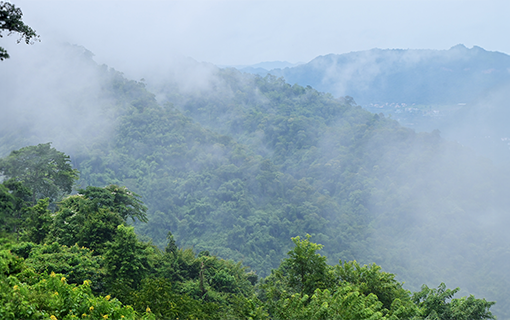
A veil of mist covering the mountain range at KM 25 Viewpoint.
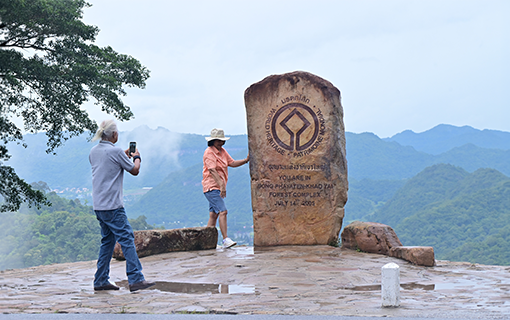
Visitors posing beside the World Heritage sign at KM 25 Viewpoint.
Mist began rising from the valley below. It was not the usual blanket of fog sitting quietly between the mountains. This mist was moving—flowing slowly from one ridge to another as though the forest itself were exhaling after the rain.
There was nothing to do except stand there and watch.
For a few minutes, Khao Yai looked less like a national park and more like a scene from a nature documentary.
Then came the monkeys.
Several appeared around the viewpoint, including one particularly curious individual that climbed onto a visitor’s motorcycle and sat there looking remarkably ready to ride away.
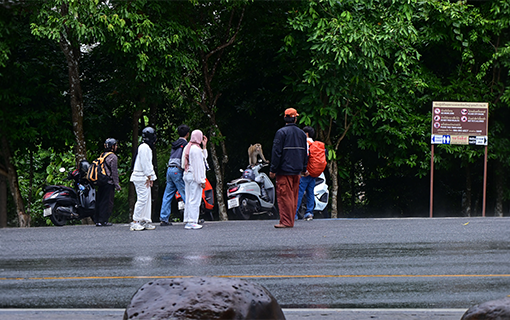
A mischievous monkey perched on a visitor’s motorcycle.
A reminder, perhaps, that in Khao Yai we are visitors in someone else’s home. Enjoy wildlife from a respectful distance, never feed animals and keep food safely stored away.
A Change of Plan — Because Nature Sets the Schedule
Our next intended destination was Pha Diao Dai, but after checking with park staff we discovered that the area was closed during our visit.
That is part of travelling in the rainy season.
Some natural attractions and trails close seasonally or temporarily for ecological recovery or because heavy rain makes conditions unsafe. Thailand’s national parks publish annual closure schedules, while temporary closures can also be announced at short notice when rainfall or water levels become dangerous.
Instead of being disappointed, we did what green-season travellers quickly learn to do:
change the plan and keep exploring.
After lunch near the park headquarters, we continued along the winding road through the park.
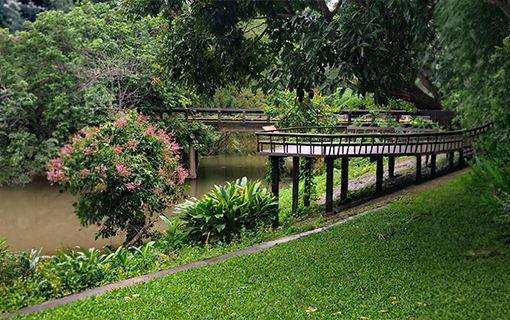
The bridge over Lam Ta Khong, viewed from the restaurant area.
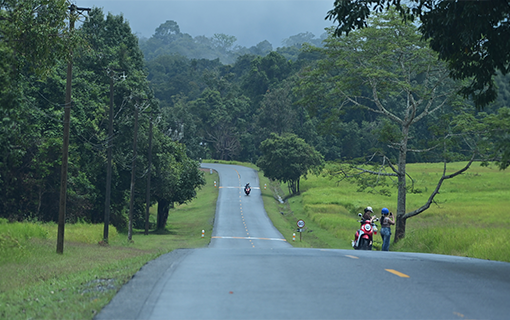
A forest road cutting through the grasslands of Nong Phak Chi.
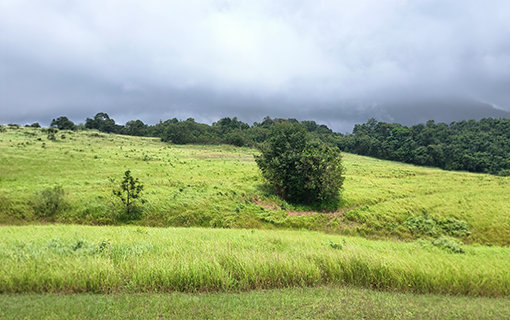
Near the open grasslands around Nong Phak Chi, a few barking deer emerged to graze. Everything around them looked freshly washed—deep-green hills, wet grass, dark tree trunks and clouds still hanging low over the forest.
The lush grasslands of Nong Phak Chi in Khao Yai
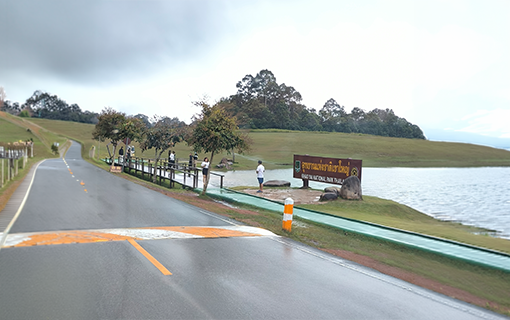
Sai Sorn Reservoir, a peaceful waterscape in Khao Yai National Park.
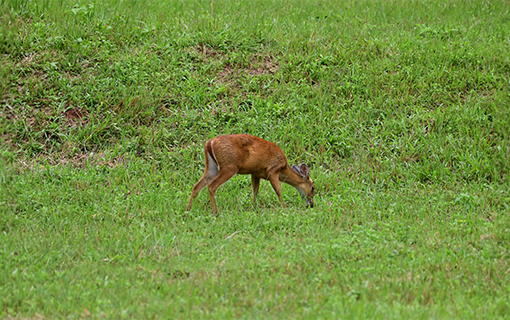
A young barking deer appearing by the roadside near Sai Sorn Reservoir.
There is a particular kind of calm that arrives after tropical rain.
Khao Yai wears it very well.
Haew Suwat Waterfall — This Is Why You Come During the Rain
Then came the highlight.
Haew Suwat Waterfall.
You may have seen it before in photographs, travel documentaries or films. But during the rainy season, photographs hardly prepare you for the sound.
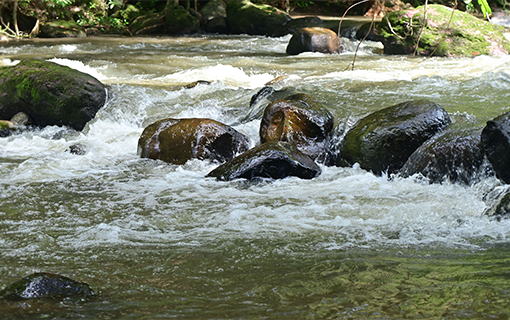
A forest stream flowing gently before descending to Haew Suwat Waterfall.
Water surges over the cliff in a broad white curtain, crashes into the pool below and sends spray drifting across the rocks.
During our visit, the water was abundant yet beautifully clear, filling almost the entire width of the falls.
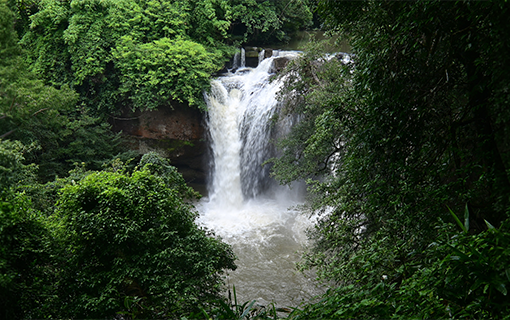
Haew Suwat Waterfall in full rainy-season beauty.
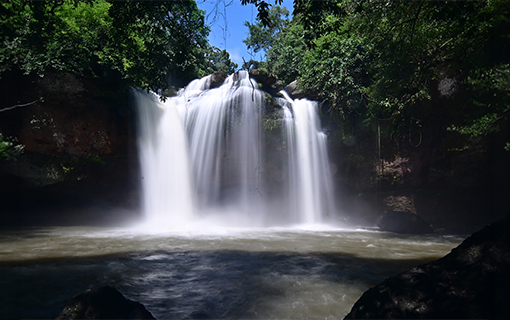
The dramatic cascade of Haew Suwat Waterfall.
Swimming was prohibited because of the strong current—and with that much water coming down, there was absolutely no argument.
We did not need to swim anyway.
Sometimes the best way to experience a waterfall is simply to sit, listen and take it in.
The thunder of the water.
The cool mist against your skin.
The saturated green of the forest.
The feeling that everything around you is growing.
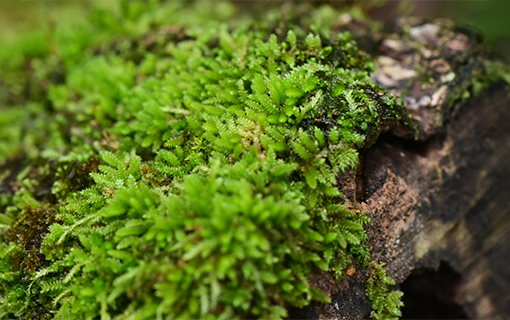
Moss and ferns carpeting the forest in vibrant green.
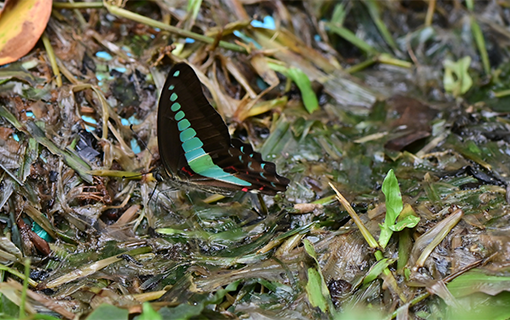
A Common Bluebottle butterfly spotted near the Haew Suwat Waterfall parking area.
This is what a rainy-season journey is really about.
Not avoiding the weather, but discovering what the weather creates
One More Stop Before Heading Home
Since Pha Diao Dai had been taken off the day's itinerary, we unexpectedly had some extra time.
So instead of rushing back to Bangkok, we descended towards the Prachinburi side of Khao Yai and stopped at Noen Hom Café.
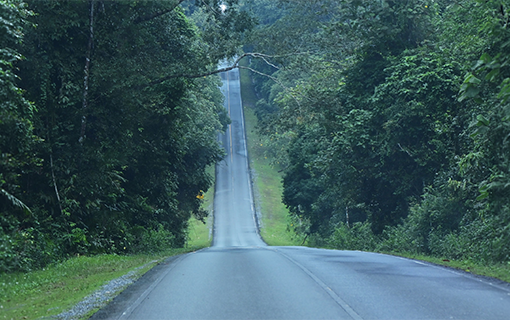
The forest road connecting Khao Yai and Prachinburi.
Surrounded by trees despite its roadside location, the café provided a wonderfully quiet finale to the day. Its house-and-garden design was much more charming than we had expected—proof that sometimes the unplanned stops become part of the memory too.
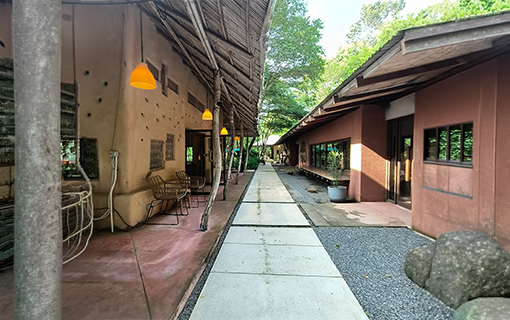
Noen Hom Café, a charming stop on the Prachinburi side of Khao Yai.
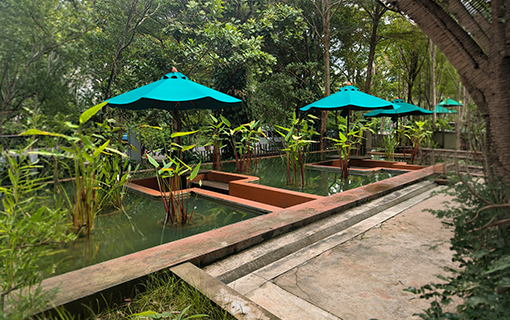
The peaceful atmosphere of Noen Hom Café, surrounded by greenery.
Coffee after waterfalls and mountain rain?
Definitely not a bad way to finish a forest trip.
Want to Stay Longer?
Although this journey works perfectly as a day trip, staying overnight lets you experience another side of Khao Yai.
Nature lovers can look into accommodation within or around the national park, while camping offers an even closer connection with the forest. Lam Ta Khong remains one of Khao Yai's popular camping areas, and the park has continued to introduce measures to improve visitor safety in areas where wild elephants may occasionally appear.
For hikers, Khao Yai also offers forest trails where the experience becomes much more immersive: wet leaves underfoot, giant trees overhead and the continuous sounds of insects, birds and flowing water.
Just remember that rainy-season conditions can change quickly. Check current park announcements and trail accessibility before setting out, follow ranger instructions and never enter a closed area.
Rainy Season Is Not the “Low” Season for Nature
Perhaps we need to rethink the expression low season.
Hotel prices may be lower.
Visitor numbers may be smaller.
But nature?
Nature is operating at full volume.
The waterfalls are stronger. The forest is greener. Wildlife is active. Mist can appear without warning. And familiar destinations suddenly feel completely different.
You might get wet.
Your itinerary might change.
You may even have to give up one viewpoint and discover somewhere unexpected instead.
But perhaps that is exactly the point.
Travel does not always have to happen under perfect blue skies.
Sometimes the most memorable journeys begin with rain.
Travel Khao Yai with Pacific Leisure
Whether you are looking for an easy nature escape from Bangkok, a private green-season journey, a wildlife experience or a slow adventure through Thailand’s national parks, Pacific Leisure can help turn the rainy season into a reason to travel.
Come for the greener forests, fewer crowds and waterfalls at their wildest—and discover why Thailand can be even more beautiful when it rains.
Editor in Chief : Nampetch Siramanon
Editor: Pacific Leisure (Thailand)
Content Creator : Mr. Saroj Na Ayutthaya
Navigate
Terms & Privacy
Pacific Leisure (Thailand) Limited
No. 888/154, Mahatun Plaza Bldg., 15th Floor,
Ploenchit Road, Lumpini, Pathum Wan,
Bangkok 10330, Thailand
Phone : +66 22 542 966
Mobile : +66 63 224 1384, +66 81 138 2983
Email : info@pacificleisureth.com
Website : https://www.PacificLeisureTH.com
(TAT) Licensed No: 11/00161